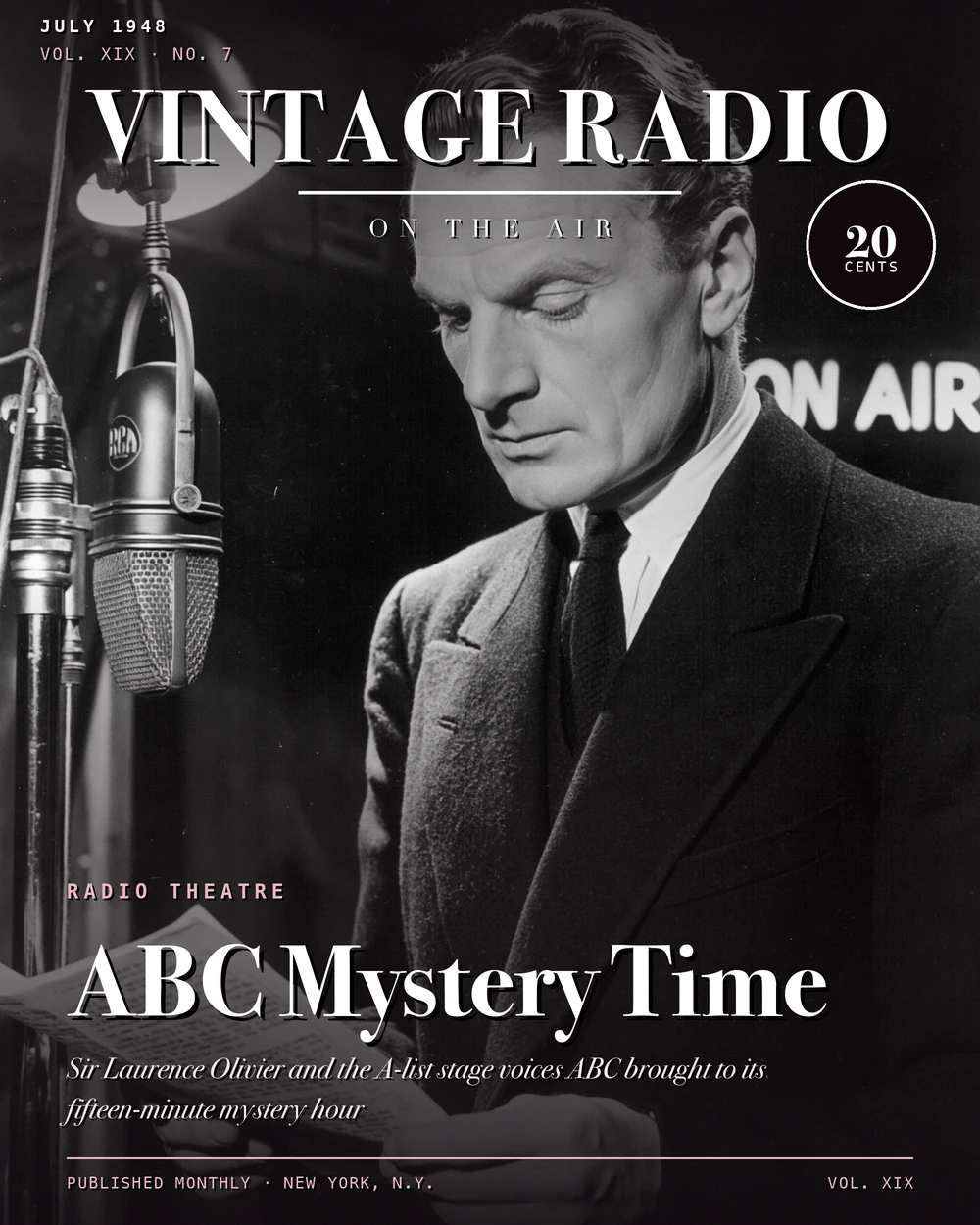
ABC Mystery Time
The Short Form That Aimed High
Fifteen minutes is not much time to set a scene, build dread, and deliver a satisfying twist. Most shows that tried the format settled for thin plots and stock characters. ABC Mystery Time had a different idea: book the best stage and film actors available, adapt serious literary material, and trust that the writing and performance could do in a quarter-hour what other shows needed an hour to attempt. The results, at their best, were extraordinary — and the show's ambition explains why it's remembered at all, given how little of it actually survived.
The program aired Thursday nights at 8:30 on the American Broadcasting Company, hosted by Don Dowd, with episodes running about fifteen minutes each. Known file dates span from October 1947 to May 1956, suggesting a run that extended well into the mid-1950s — longer than early accounts implied. Roughly 17 episodes were produced, though only a fraction survive today.
The Talent ABC Went After
The most striking thing about ABC Mystery Time is who the network was willing to hire. The show took its cue from CBS's Escape by adapting classic literature, and backed that ambition with a genuine willingness to pay for A-list movie talent. The names on the roster read like a casting director's wish list: John Gielgud, Ralph Richardson, Michael Redgrave, Orson Welles, and Sir Laurence Olivier all appeared on the program.
Getting stars of that caliber onto a fifteen-minute radio mystery was made possible in part by the technology the show used. ABC Mystery Time was taped via magnetic recording — using either the German Magnetophon or the newer AMPEX process — rather than broadcast live or transcribed by older methods. That flexibility let A-list performers record their episodes around their film and stage schedules, which made appearances logistically feasible in a way they wouldn't have been under the old live-broadcast model.
Olivier's work stands out in particular. His performances in adaptations of Oscar Wilde's "The Picture of Dorian Gray" and "The Suicide Club" are considered the highwater marks of the series — the clearest examples of what the program could achieve when the material and the performer were perfectly matched. Both titles appear in the surviving catalog.
Don Dowd and the ABC Mystery Block
Host Don Dowd was one of several announcers for The Breakfast Club on NBC and ABC over roughly twelve years, and he hosted other ABC programs as well. On ABC Mystery Time, his role as host gave the short episodes a consistent frame and helped establish the mood before the story began.
The program was part of a weeknight mystery and thriller block ABC scheduled at 8:30. The lineup gave each weeknight its own show: Mike Malloy Private Eye on Monday, The Adventures of Sherlock Holmes on Tuesday, Mystery Classics on Wednesday and Thursday, and Police Blotter on Fridays. Dowd hosted across multiple entries in that block, making him the recurring voice threading the network's mystery programming together each week.
ABC itself was a young and cash-strapped network during these years. It had been formed when RCA divested its Blue Network in 1943; Edward J. Noble — the Life Savers candy magnate — purchased it for $8 million and renamed it the American Broadcasting Company. From the start, ABC struggled to compete with NBC, CBS, and the Mutual Network. Booking names like Olivier and Welles for a short-form anthology was partly a way of punching above the network's weight, giving ABC programming that could stand beside anything the larger networks offered.
What the Episodes Were Like
The stories ranged across the mystery genre's full spectrum: classic whodunits, chilling ghost stories, and literary adaptations that brought genuine weight to the short format. The production relied on skilled voice acting and sound effects built to heighten suspense, with sharp "organ rips" — creaky, atmospheric organ stings — punctuating the action and signaling shifts in tension. Those stings are mentioned consistently enough in OTR sources that they seem to have been a signature of the show's sound design.
Known episode titles give a reasonable picture of the range. "Murder In Haste," "Death Walked In," and "Death by Proxy" sit at the pulpier end. "Four Fatal Jugglers," "My Adventure in Norfolk," and "No One Will Ever Know" suggest something more unusual. "The Overcoat" — likely the Gogol story — and "The Picture of Dorian Gray" confirm the show's literary ambitions. Additional titles beyond the main catalog include "The Suicide Club," "Success Story," and "The Tale," which appear on a 13-episode commercial release alongside the catalog's other titles.
One catalog cross-references the show alongside Five Minute Mysteries and I Love a Mystery — shorter or anthology-style mystery programming that shared the same compressed, punchy format.
What Survived — and What Didn't
ABC Mystery Time arrived late enough in the Golden Age of Radio that survival should have been nearly guaranteed. The shift to magnetic tape recording, which the show itself used, meant episodes were theoretically more durable than the acetate transcriptions of earlier decades. And yet a significant number didn't make it. Of the roughly 17 episodes believed to have been produced, the surviving record is incomplete.
The count varies depending on the source. One CD release lists 13 distinct episode titles; another catalog lists 26 recordings with a total playtime of around 10 hours and 18 minutes, with file dates stretching from 1947 to 1956 — which suggests either multiple recordings of some episodes, or a run longer and more varied than the tidy episode count implies. The show was also broadcast under alternate titles — "Masters of Mystery," "Mystery Time Classics," and simply "Mystery Time" — which may account for some of the variation across different catalogs and collections.
For a program that landed Olivier, Welles, Gielgud, and Richardson in the same short-form anthology, the survival record is a genuine loss. What remains holds up. The fifteen-minute format, the magnetic tape flexibility, the literary ambitions, and the organ rips that punctuated every turn — it adds up to a show that was doing something specific and doing it well, even if the full picture can no longer be assembled from what's left.